
What does it cost to automate an existing driveway gate?
You already paid for the gate. Now you're tired of getting out of the car in the rain, in the dark, with groceries, to drag it open. Good news: most solid gates can be automated without being replaced. Here's what goes into it, what drives the cost, and how to avoid paying twice.
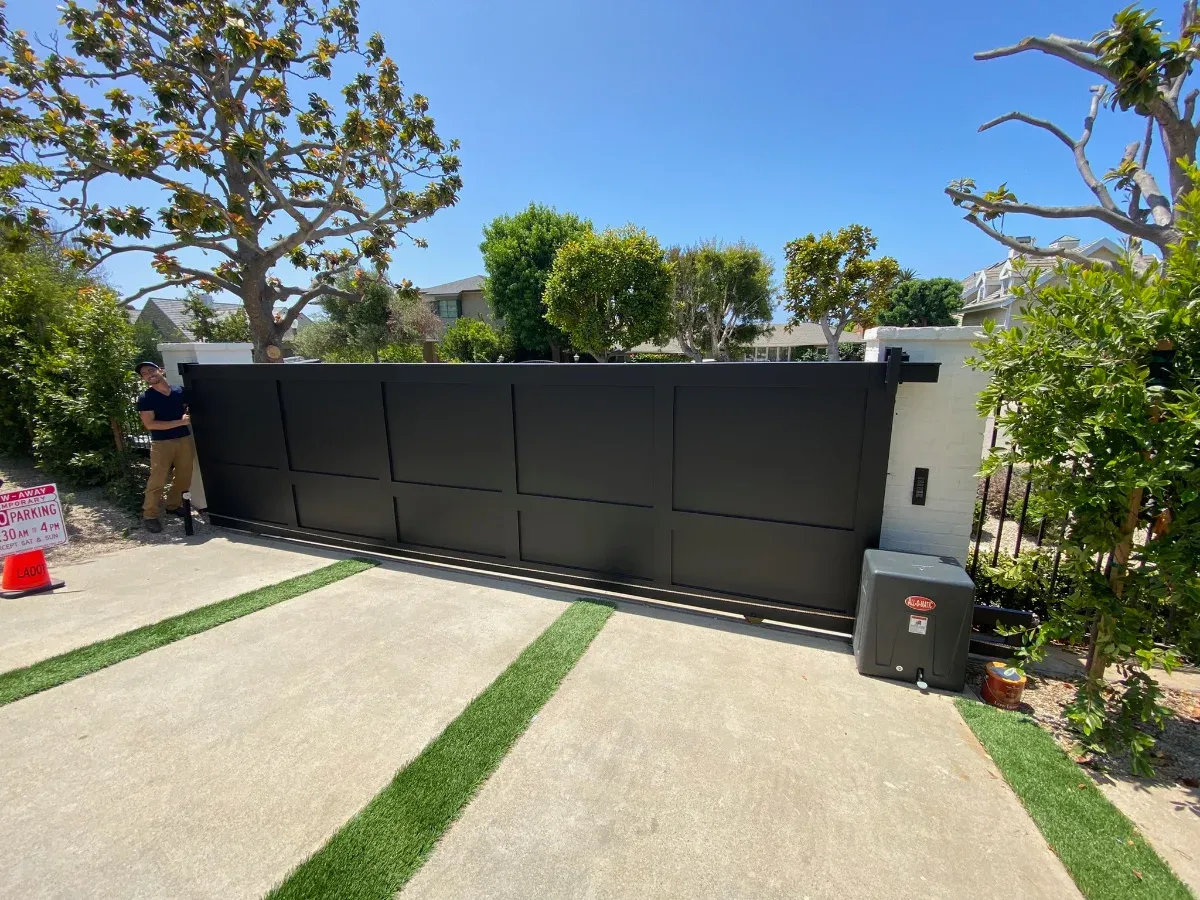
01The short answer
- Automating a single residential driveway gate in Southern California starts at $3,500. Double swing gates and underground operators run higher.
- The operator itself is only part of the bill. Power to the gate, the safety devices the code requires and any fixes the gate needs first often add up to as much.
- Your gate has to be strong, swing or roll freely by hand, and meet the ASTM F2200 construction standard before it gets a motor. Some older gates need hinge, roller or infill work first.
- Solar can replace a long, expensive power run on low-traffic gates.
- Budget for how people get in: remotes come with most operators; keypads, video intercoms and phone apps are add-ons.
02What goes into the price
Gate automation starts at $3,500, as of November 2026. Not a quote. Your price comes after a site visit, in writing, before any work starts.
Can the gate you already have be automated?
Most can. The question is whether the gate is ready for a motor, because an operator pushes a gate thousands of times a year and finds every weakness.
Start with a simple test: unlatch it and move it by hand. A swing gate should swing smoothly without sagging or dragging. A slide gate should roll the full length of its track without catching. If it takes real effort to move, fix that first, because an operator won’t fix it for you. It’ll just wear itself out fighting.
Then there’s the standard. Automated gates have to meet ASTM F2200, the construction standard for vehicular gates. It covers things a manual gate never had to worry about: openings near the ground on slide gates small enough that a hand can’t reach through, covered rollers, and no pinch points where the gate meets the post. Plenty of older ornamental gates need a few changes, such as mesh infill at the bottom, roller guards or new hinges, before they’re safe to automate. A good installer tells you this before quoting the operator, not after.
Which operator fits your gate?
The gate decides the family; the weight, length and traffic decide the model.
- Swing gates take an arm-style operator mounted on the post, an articulated arm for tight pillars, or an underground operator hidden in a box below the hinge. Arm operators cost least. Underground units are invisible from the street and cost the most.
- Slide gates take an operator that drives a chain or rack along the gate. Light units handle typical residential gates. Long, heavy or busy gates need commercial-grade operators.
Operators are also built for a duty level. Under UL 325, the safety standard for gate operators, residential gates are a different class from commercial and industrial ones. A light residential unit on a busy shared driveway is the most common way people end up paying for a second operator a few years later. Our swing vs. slide guide and underground vs. articulated vs. surface guide go deeper if you’re choosing.
Power: run a line, or go solar?
Every operator needs power. You have two options:
- A power line from your panel. It’s the right call for busy gates, heavy gates and anything with an intercom or camera. The cost is mostly trenching: a short run across a lawn is cheap, while a long run under concrete or across the driveway is not.
- Solar. A panel charges the operator’s batteries, so there’s no trench at all. It works best on gates that open a handful of times a day and get good sun. Shade, winter and heavy traffic are where solar falls short.
Either way, look for an operator with battery backup. It keeps the gate working through most outages, and that matters when the gate is the only way in or out.
The safety devices you’re required to add
This is the part people don’t budget for, and it isn’t optional. UL 325 requires operators to monitor their external entrapment protection: photo eyes that see across the opening and edge sensors that stop the gate when it touches something. If a required device is missing or faulty, a compliant operator won’t close on its own.
How many you need depends on the gate. A swing gate needs protection in its swing path; a slide gate needs it at the leading edge and along the run. Think of these devices as part of the operator, because without them you don’t have a working automatic gate. You have a liability.
How people will get in
Most operators come with remotes. After that, it’s your call:
- Keypad. A code for guests, deliveries and the dog walker. The least expensive add-on.
- Video intercom. See who’s at the gate and let them in from your phone, from anywhere.
- Phone app or cellular control. Open the gate from an app, set schedules, and see every open and close.
- Exit loop. A sensor in the drive that opens the gate automatically as a car leaves, so no one needs a remote to get out.
We break down the entry options, and what each one costs, in keypad, video intercom or phone app.
Permits, HOAs and the fire department
Three groups may want a say before the gate starts moving on its own:
- Your city. Usually an electrical permit for the power run. Some cities also review gate height and setback.
- Your HOA. Most want to approve anything visible from the street, including the operator.
- The fire department. If the driveway is a fire access road, the California Fire Code (section 503.6) requires an approved way for fire crews to open the gate in an emergency. Around Los Angeles that’s your local fire department, such as LAFD or LA County Fire, and the device is often a key switch or a siren-activated sensor.
What a retrofit looks like, start to finish
- Site walk. We check the gate, frame, hinges, grade and power, and how cars actually approach the entrance.
- Operator sizing. The motor is matched to the gate’s real weight and how often it will run.
- Prep. Any hinge, roller, reinforcement or ASTM F2200 work gets done first.
- Install and test. The operator, safety devices and entry options go in, and every safety device is tested before we hand it over.
A single-gate retrofit usually takes one to two days on site once parts are in. Long power runs and underground operators take longer.
10What drives the price up or down
- Gate weight and sizeA heavy steel gate needs a bigger operator, stronger hinges or rollers, and sometimes a reinforced frame.
- Distance to powerEvery foot of trench between your electrical panel and the gate costs money, and crossing concrete or pavers costs more.
- How often it opensA busy shared drive or a business needs a high-duty operator rated for many cycles a day, not a light residential one.
- Condition of the gateA gate that drags, sags or has big openings near the ground needs work before any operator goes on.
- Entry and extrasKeypads, intercoms, phone apps, cameras and exit loops are all optional, and they add up fast.
11Questions people ask
Can my existing gate be automated?
Usually, yes, if it's structurally sound and moves freely by hand. The gate also has to meet ASTM F2200, the construction standard for automated gates, which covers things like openings near the ground on slide gates, exposed rollers and pinch points. Some older gates need hinge, roller or infill work before an operator goes on.
How much does it cost to automate a driveway gate in Southern California?
It starts at $3,500 for a single residential gate. Double swing gates, underground operators, long power runs and video intercoms push it higher. You get the exact price in writing after a site visit.
Should I get a swing operator or a slide operator?
That depends on the gate you have. A swing gate gets a swing operator and a slide gate gets a slide operator. Inside each type you choose between arm, articulated or underground swing operators, or light and heavy-duty slide operators, based on weight, length and traffic.
Do I need to run electricity to the gate?
Most operators need power, either a line from your panel or a solar panel that charges the batteries. Solar works well for gates that open a few times a day. Busy gates and long, heavy gates usually need a hard power line.
Will an automatic gate work during a power outage?
Operators with battery backup keep running through most outages, and every operator has a manual release so the gate can be opened by hand. Backup batteries are a wear item and usually need replacing every 3 to 5 years.
Do I need a permit to automate my gate?
Often you need an electrical permit for the power run, and HOAs usually want to approve the hardware. If your driveway is also a fire access road, the fire department requires an approved way for its crews to open the gate.
Can you automate a gate another company built?
Yes. We start with a structural check of the gate, frame and hinges, size the operator to the gate's real weight and traffic, and tell you in writing if anything needs fixing before automation.