
Keypad, video intercom or phone app: how to choose gate entry for your home
Your gate is only as convenient as the way people get through it. Get it right and family, guests, deliveries and the pool guy come and go without a single call to you. Get it wrong and you're the doorman, walking down the driveway to let someone in while dinner burns. Here's every option, what it's good at, and what it costs.
01The short answer
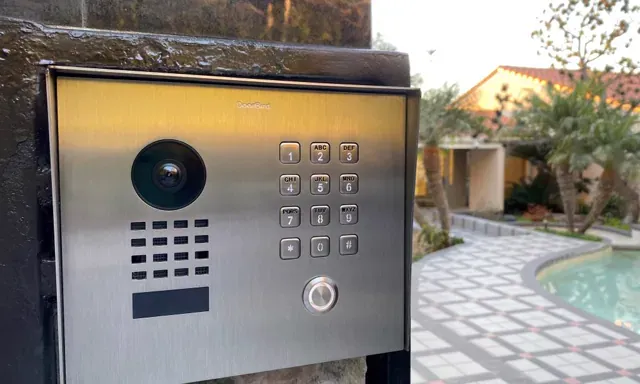
- For most homes the winning setup is a video intercom with a built-in keypad, phone-app control, and remotes for the people who live there.
- A keypad alone is the cheapest way to let guests and deliveries in, but codes spread and you can't see who's using them.
- A video intercom lets you see and talk to whoever is at the gate and open it from your phone, from anywhere.
- Cards, fobs and license plate recognition earn their cost when the same people or vehicles come through every day.
- The hidden cost is almost always power and a reliable network connection at the gate, not the device itself.
02Starting prices for each option, installed
Starting prices in Southern California, November 2026. Not a quote. Your price comes after a site visit, in writing, before any work starts.
Start with who needs to get in
Before you pick a device, list the people. It takes two minutes and it decides everything.
- The household. People who come and go several times a day want the fastest option: a remote in the car, the app, or their plate.
- Regular guests and staff. House cleaners, nannies, gardeners and family. Each one should have their own code or credential, so you can cut off one person without changing everyone’s access.
- Deliveries and visitors. Strangers you want to see before you let them in.
- Emergency access. If your driveway is a fire access road, the fire department needs its own way in, and that’s not optional.
Most homes end up with a mix. The trick is choosing a system that handles the mix without you standing in the driveway.
Keypads: the cheapest way to share access
A keypad lets anyone with a code open the gate. It’s fast, it’s familiar, and it’s the least expensive add-on there is.
Wireless keypads mount on a post and talk to the operator by radio, so there’s no trenching. Wired keypads sit on a gooseneck pedestal at driver-window height and run through conduit to the operator. They cost more to install, never need batteries and don’t drop out.
The weakness is the code itself. Codes get shared, written down and passed along. Give every regular visitor their own code, delete codes when people stop coming, and a keypad works well. Use one code for everyone and it slowly stops being a lock.
Video intercoms: see who it is before you open
A video intercom is a camera, a speaker and a call button at the gate. A visitor presses the button, your phone rings, and you see and talk to them from anywhere: the kitchen, the office or another country. Tap to open, or don’t.
Many include a keypad and some include a card reader, so one device at the gate does everything. Calls and visits can be recorded, which is useful when a package goes missing.
Video needs two things at the gate: power and a solid network connection. That’s where most intercoms fail. Wi-Fi from the house rarely reaches the end of a long driveway reliably, which means dropped calls and a gate that won’t answer. The fix is a cable run in conduit or a dedicated wireless bridge, and it’s worth doing right the first time.
Phone-app and cellular control
Want to open the gate from your phone without a visitor calling first? A gate controller adds app control to the operator you already have.
- Wi-Fi controllers are inexpensive and work well when your network reaches the gate.
- Cellular controllers carry their own connection, so they work even where Wi-Fi doesn’t. They usually come with a monthly plan.
Most apps also give you schedules, so the gate opens for the landscaper at 8 every Tuesday and nobody else, and a log of every open and close. That log is often the only record of who came through and when.
Cards, fobs and plates for people who come every day
If staff, tenants or the same vendors come through daily, credentials beat codes. Each card or fob belongs to one person, can be cut off in seconds, and logs every use.
For vehicles, license plate recognition reads the plate as the car approaches and opens the gate for approved vehicles without anyone touching anything. It’s the smoothest entry there is, and it logs every car in and out with the plate attached. We explain how it works, and why it works or fails, in what is LPR.
The detail that sinks most installs: power and network at the gate
The device you see is the easy part. Behind every reliable intercom, app controller, card reader and plate camera is power and a network connection that doesn’t quit. A great intercom on a weak Wi-Fi signal is a bad intercom.
That’s why we plan the gate’s power and network along with the entry hardware, not as an afterthought: conduit from the house, a cable run or a point-to-point wireless bridge, and backup power for when the lights go out. If you’re adding an operator too, plan it all together. See what it costs to automate an existing gate.
Our pick for most homes
For a typical gated home, here’s the setup we’d recommend:
- A video intercom with a built-in keypad at the gate, so guests get codes and strangers get a face-to-face call.
- App control for everyone who lives there, with schedules for regular service people.
- Remotes in the household cars, because nothing is faster.
- A hard-wired network connection or a wireless bridge to the gate, so the whole thing actually works.
Add plate recognition if your household is in and out all day, and cards or fobs if you have staff.
10What drives the price up or down
- Distance from the houseEvery foot between the gate and your network or electrical panel is trenching, cable or a wireless bridge.
- Wired or wirelessWireless is cheaper to install and easier to add later. Wired is sturdier and doesn't drop out.
- How many people and doorsOne household is simple. Staff, tenants, a pedestrian gate and a vehicle gate means more readers and more credentials.
- Monthly plansSome systems are buy-once. Others charge every month for the app, cloud recording or a cellular connection.
- Your existing operatorOlder operators may need an add-on board or relay before a newer intercom or app can control them.
11Questions people ask
What's the best way to let guests through my gate?
A video intercom with a keypad covers almost everyone. Regular guests get their own code, and anyone else presses the call button so you can see them and open the gate from your phone.
Can I open my gate from my phone?
Yes. A video intercom with app answering, a Wi-Fi gate controller or a cellular gate controller all let you open the gate from your phone. Cellular controllers work even when your home Wi-Fi doesn't reach the gate, usually for a monthly fee.
Is a wireless keypad secure enough?
For most homes, yes, as long as each person gets their own code and old codes are deleted when someone stops coming. The bigger risk is a single shared code that ends up written on a delivery slip.
Do video intercoms have monthly fees?
Some do and some don't. Many residential video intercoms work through a free app, while cloud-managed and cellular systems usually charge a monthly plan. We'll tell you which is which before you choose.
Will a new intercom or keypad work with my existing gate operator?
Usually. Most intercoms and keypads trigger the operator through a simple relay input. Some older operators need an add-on board first, which we check on the site walk.
How much does gate entry cost to install?
In Southern California a wireless keypad starts at $250 installed, a video intercom at $2,500, and phone-app control at $750. Getting power and a network connection to the gate is often the biggest variable; call 661-605-3266 for pricing on that.